
Littoz-Monnet Annabelle, Montes-Ruiz Leandro, and Juanita Uribe (Forthcoming Special Issue) “The Pluralization of Expertise. The Good, the Glamourous, and the Political” Review of International Studies.

Littoz-Monnet Annabelle, Montes-Ruiz Leandro, and Juanita Uribe (forthcoming) “Bringing the Economic back! ! Thinking about the Politics of Expertise within and Beyond the Social” International Political Sociology..

Uribe, Juanita (2026) “From Boundary Work to Boundary Navigation: Expert Consultants in Multistakeholder Governance.” In Jan Eijking (ed.), Experts in a Turbulent World. Oxford University Press.

Jaramillo Ruiz Felipe and Juanita Uribe. 2026. “Epistemic Inertia in Human Rights Expert Bodies: Continuity amid Pluralisation”. Review of International Studies.
In this articule Felipe Jaramillo Ruiz and Juanita Uribe introduce the heuristic of epistemic inertia to complicate narratives of radical rupture in global sites of expertise. In 2006, the United Nations adopted the Convention on the Rights of Persons with Disabilities (CRPD), widely celebrated as a radical break from the medical model, which had long framed disability as an individual impairment to be treated by medical doctors. Through the heuristic of epistemic inertia, they examine how, despite adopting a more pluralised expert repertoire, the CRPD Committee retains some deep-seated (neo)liberal assumptions of the medical model. Read the full article here.


Littoz-Monnet, Annabelle. 2024. “Knowledge Machineries and their Objects of Expertise. Knowing Bodies, Moves, and Moods through ‘Mobile Health’ Data”. Global Studies Quarterly 4(3).
In this articule, Annabelle Littoz-Monnet argues that the politics of socio-material objects should be examined in relationship with the machineries of knowing these objects are embedded in and also sustain. Objects of expertise are embedded in discursive constructs, material infrastructures, and relationships that “surround” and permeate their production. In turn, such objects give traction to the machineries of knowing that enable their emergence. The article uses the concept of “knowledge machinery,” coined by sociologist of science Karin Knorr-Cetina, to denote a focus on the “machinery” and its “parts” at the same time, or to the “macro” and the “micro,” as highly intertwined and mutually reinforcing in processes of knowledge production Read the full article here.

Littoz-Monnet, Annabelle and Ximena Osorio Garate. 2023. “Knowledge politics in global governance: philanthropists’ knowledge-making practices in global health”, Review of International Political Economy, 31(2): 755-780.
In this article, Annabelle Littoz-Monnet and Ximena Osorio-Garate highlight that philanthropic organizations now shape governance by acting as producers of knowledge. Practicing ‘knowledge philanthropism’, they collect, produce and assemble the data, calculations and research which is used by International Organizations (IOs) to govern problems. In addition, philanthropies craft tools of interpretation, whether concepts, vocabularies, or concrete technological devices that embed these, which are being used for the treatment of the knowledge they themselves produce. Read the full article here.
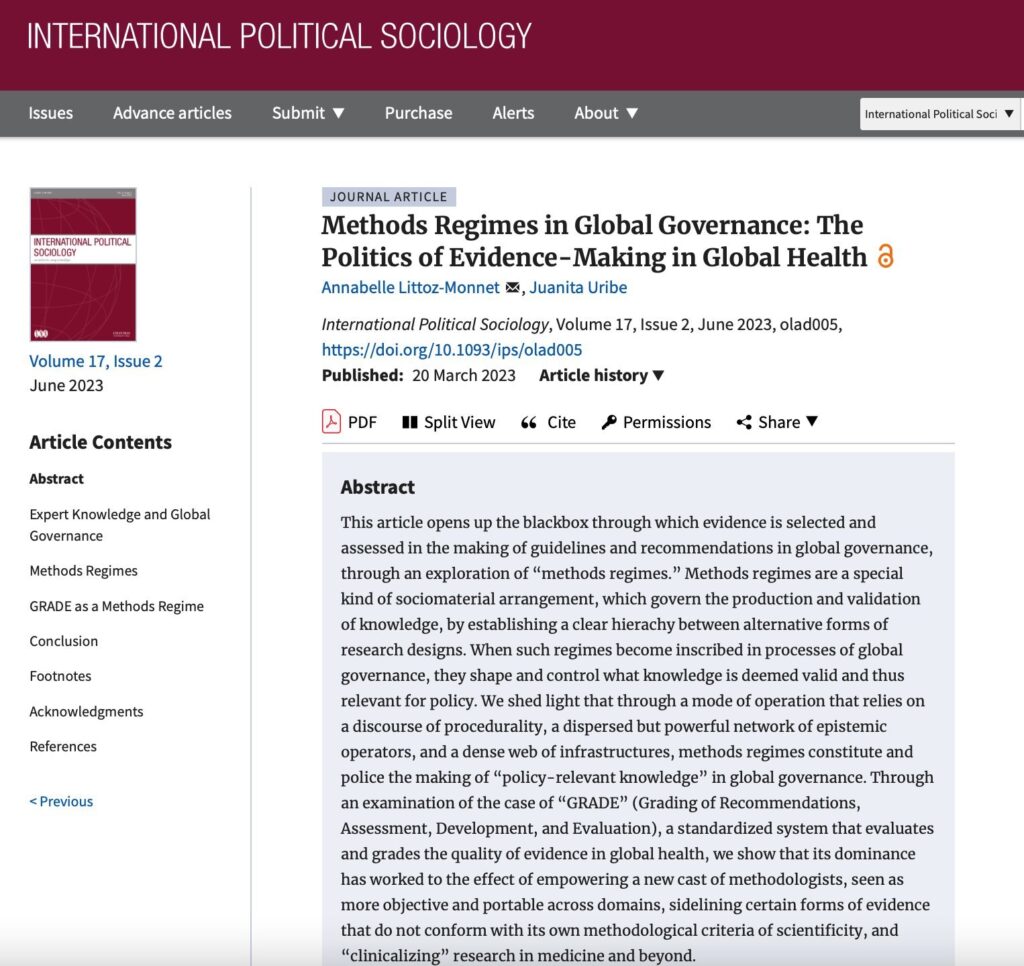
Littoz-Monnet, Annabelle and Juanita Uribe. 2023. “Methods Regimes in Global Governance. The Politics of Evidence-Making in Global Health”, International Political Sociology.
In this article, Annabelle Littoz-Monnet and Juanita Uribe open up the blackbox of the selection and assessment of evidence in the making of guidelines and recommendations in global governance, and show how methods are central to understanding the politics of evidence making and assembling in global health. Read the full article here.
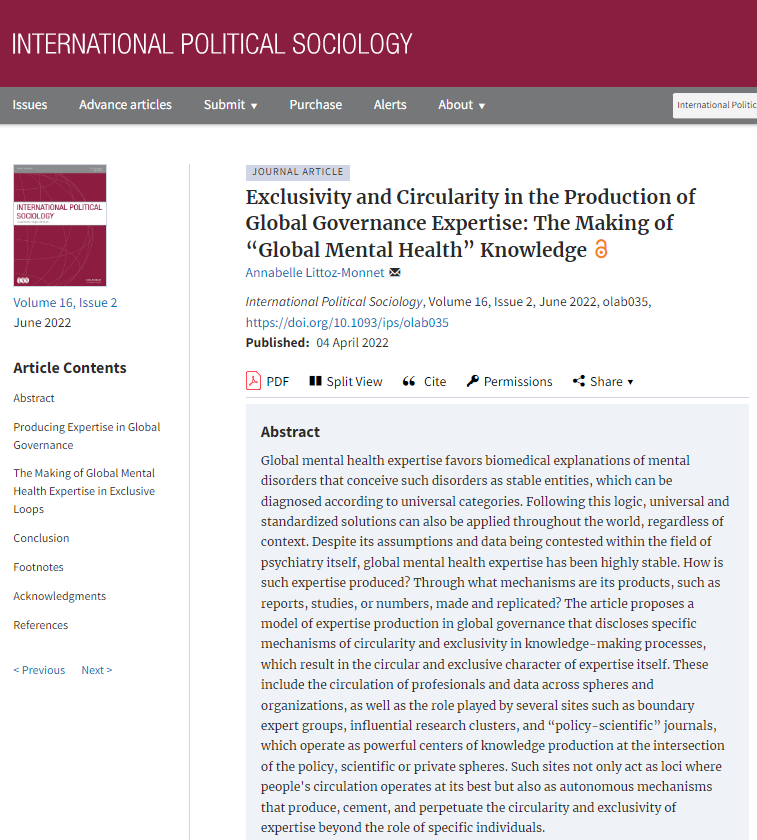
Littoz-Monnet, Annabelle. 2022. “Exclusivity and Circularity in the Production of Global Governance Expertise: The Making
of ‘Global Mental Health’ Knowledge”, International Political Sociology, 16(2).
In this article, Annabelle Littoz-Monnet unpacks the mechanisms of exclusivity and circularity in the production of the reports, numbers, and studies that constitute global mental health expertise. Read the full article here.